

What Are Executive Functions in ADHD, And Why Do They Matter So Much?
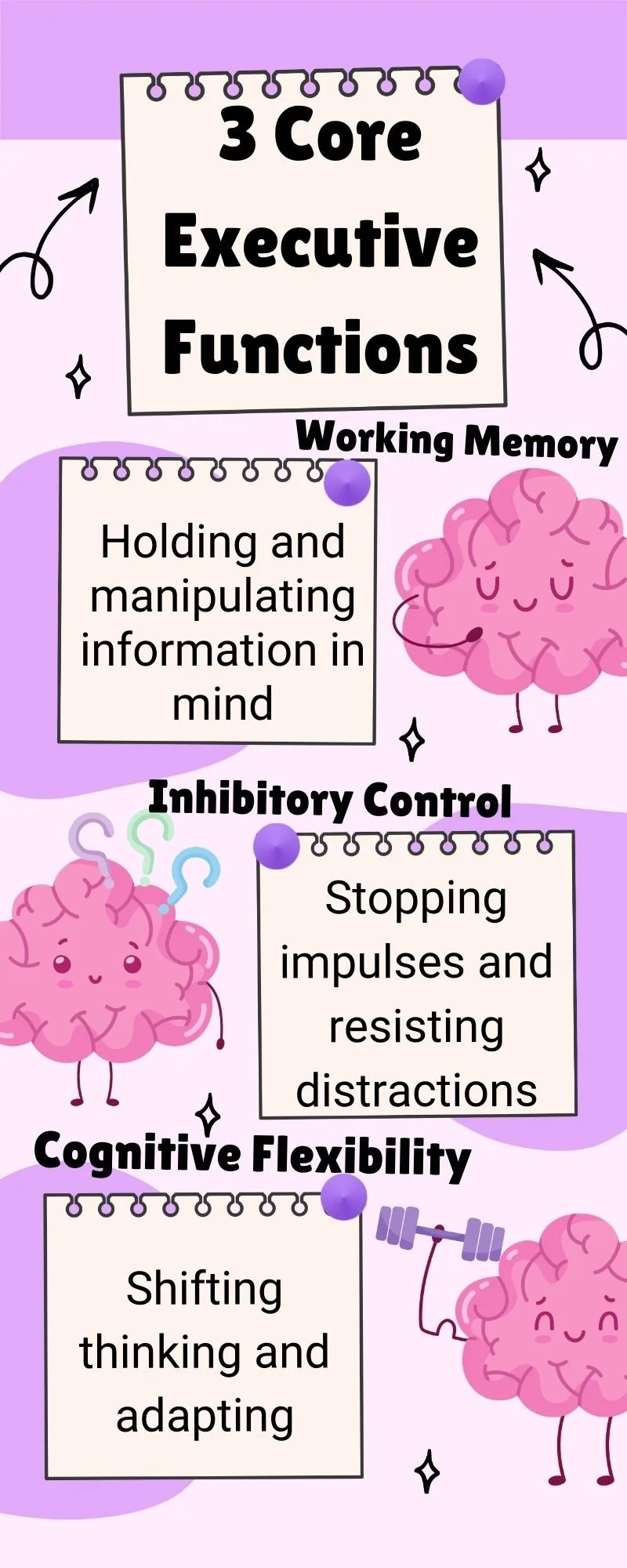
Executive functions (EF) are higher-order cognitive processes that help us regulate attention, emotions, behaviour, and goal-directed actions. In ADHD, executive function challenges — especially with working memory and inhibitory control — are core features that affect school, work, relationships, and emotional regulation.
What Is Executive Function?
Executive function is the brain’s management system.
It allows us to:
Start tasks
Stay focused
Pause before reacting
Shift when plans change
Hold information in mind
ADHD is not simply an attention problem.
It is fundamentally a regulation difference, and executive function sits at the center of that difference.
How Does Executive Function Show Up in Children vs Adults?
In Children:
Trouble sitting still
Forgetting multi-step instructions
Struggling with transitions
Academic inconsistency
In Adults:
Chronic procrastination
Task paralysis
Emotional overwhelm
Difficulty prioritizing
Burnout
Many of the adults I work with describe it this way:
“I know what to do. I just can’t seem to do it.”
That gap is executive function.
Does Executive Function Predict Long-Term Outcomes?
Yes.
Research shows poorer childhood executive function predicts:
Lower academic performance
Adolescent self-control difficulties
Increased emotional distress later in life
Importantly, cognitive flexibility in childhood predicts later mental health outcomes beyond ADHD symptoms alone.
Common Questions about Executive Function
Is executive dysfunction the same as ADHD?
No. Executive dysfunction is a core feature of ADHD, but ADHD also includes persistent patterns of inattention and/or hyperactivity-impulsivity.
Can executive function improve?
Yes. Through therapy, skill-building, environmental changes, exercise, and (when appropriate) medication.
Is executive dysfunction why I procrastinate?
Often, yes. Task initiation and working memory challenges make starting and sequencing tasks harder.
Is emotional dysregulation related to EF?
Very much so. Inhibitory control and cognitive flexibility directly impact emotional regulation.
If this resonates, you don’t have to keep navigating it alone.
I offer online therapy across British Columbia, where we explore executive function challenges with practical tools and nervous system awareness.
You’re welcome to book a consultation when you’re ready.
